

Search Website
Obstetrics and Gynecology
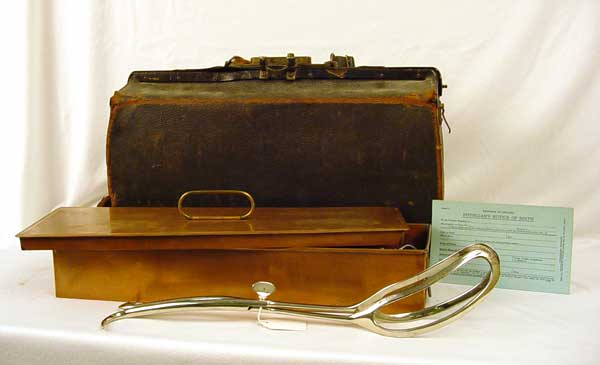
During the 19th and early 20th centuries Western medicine underwent a number of radical changes and advancements in knowledge, treatment and patient care. One such field was obstetrics and gynaecology. Traditionally women had always looked after one another in childbirth, as in other complaints, however physicians, most of whom were male, increasingly played a more important role. Physicians thought poorly of female midwives whom they perceived as untrained and dangerous. Additionally, they were considered competition for the often meager income physicians at the time earned. The medicalization of childbirth was also responsible for the general shift from homebirths to those in highly controlled hospital settings as well as the increased amount of prenatal care which was offered. These changes were welcomed by some women who were attracted to these modern options while others became disillusioned and longed for the days when they were in control of their pregnancies.
The medicalization of childbirth can be traced through the instruments used in obstetric practice during this time period. While doctors and midwives possessed different childbirth tools, there was also a difference between Protestant and Catholic practitioners when deliveries became life-threatening. Protestant physicians valued the life of the mother and would often take the life of the child in order to save the mother's life. Conversely, Catholic physicians valued the life of the unborn child, whose soul, according to church doctrine, would go to hell if it died unbaptized, unlike the baptized mother who would be welcomed into God’s waiting arms. As the procedure for a Caesarian section became safer and more routinely practiced, physicians were able to preserve the life of both mother and child in most cases.
Learning Objectives
After completing this module students will understand:
- The changing roles of women and men with regards to childbirth and the tensions between doctors and midwives
- The increasing medicalization of childbirth from the late 19th through the early 20th century and the role instruments played in bringing this about
- How religion guided both expectant mother and physician when choosing which procedures to perform
- The evolution of medical procedures in obstetrics and gynaecology
- That concepts of medicine in “legitimate” or “professional” changed according to social values, and how and by whom this legitimacy Is defined.
- The role of the doctor and patient in treatment
- Gendered meanings of medicine and health
Step 1: Objects and Their Properties
For each object answer the following questions:
- What do you think the object is and why?
- When, where, by whom and for whom was it made?
- What are the materials of which it is made? Do the materials suggest when it was made?
- What techniques were used to make it? Is it well made?
- What does the construction suggest about the date and use of the object?
- What are its physical structure, shape, size, style, ornamentation?
- Are there parts missing from the object as a whole?
- What kind of writing does it have on it, if any?
- For what use was it originally intended? Who would have used this object and where?
- What, if any, changes in ownership, condition and function have occurred over time?
Delee's-Hillis Foetal Stethoscope database entry
Alternative Images
180° View (requires QuickTime) (1.2Mb)
Midwifery Forceps database entry
Alternative Images
180° View (requires QuickTime) (1.2Mb)
Cranioclast database entry
Alternative Images
180° View (requires QuickTime) (1.2Mb)
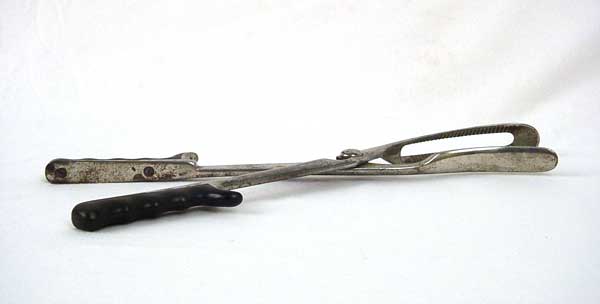
Nipple Shields database entry
Alternative Images
Perforators database entry
Alternative Images
180° View (requires QuickTime) (1.2Mb)
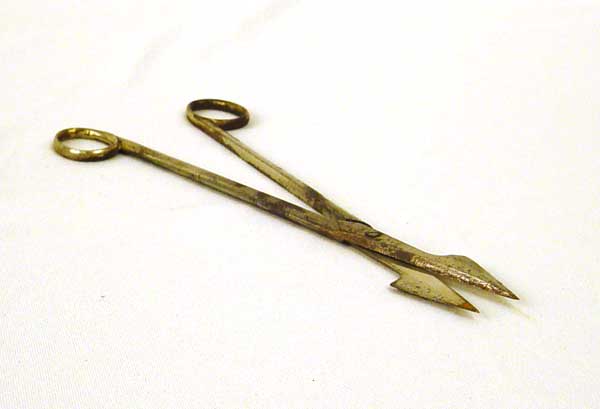
Crochet database
Alternative Images
180° View (requires QuickTime) (1.2Mb)
Step 2: The Meaning of an Artifact
For each object answer the following questions:
- Has your research confirmed your original identification of the object?
- Evaluate it: Rank its aesthetic and functional qualities, considering the material, texture, skill of craftsmanship, effectiveness of overall design, the expressiveness of its form, style and ornamentation.
- What does the object's function reveal about the philosophy of medicine and health at the time?
- What does the location of its use reveal about the role of the doctor and the role of the patient in health and medicine?
- What does the object’s function reveal about the relationship between the doctor and the patient?
- What does the object reveal about what is considered to be "natural" and "unnatural" in health and medicine?
- What does the object reveal about ethics in medicine?
Kirk-Montgomery, Allison and Shelley McKellar. Medicine and Technology in Canada: 1900-1950. Ottawa: Canadian Museum of Science and Technology, 2008.
Tew, W. P. “The Use and Abuse of Obstetrical Forceps.” Canadian Medical Association Journal 15:10 (1925): 1031-1034.
Andison, A. W. “Caesarean Section.” Canadian Medical Association Journal 56:2 (1947): 170-177.
Lusk, William Thompson. The Science and the Art of Midwifery. New York: D. Appleton & Co., 1886, 414-415, 418-419.
Selected References for Further Research
Primary Sources
Barnes, Robert. Lectures on Obstetric Operations, Including the Treatment of Haemorrhage, and Forming a Guide to the Management of Difficult Labour. London: Churchill, 1870.
Fisher & Burpe Division of American Hospital Supply Corporation Canada Ltd. Catalogue, 1961.
Ramsbotham, Francis H. The Principles and Practice of Obstetric Medicine and Surgery, in Reference to the Process of Parturition. London: John Churchill, 1844 2nd. Ed.
Secondary Sources
Bennion, Elisabeth. Antique Medical Instruments. Berkeley: University of California Press, 1979.
Bourgeault, Ivy Lyn. Push: The Struggle for Midwifery in Ontario. Montreal: McGill-Queen’s University Press, 2006.
Cahill, H.A. "Male Appropriation and Medicalization of Childbirth: An Historical Analysis." Journal of Advanced Nursing 33:3 (2001): 334-42.
Wilbur, Keith C. Antique Medical Instruments, ed.5. Atglen: Schiffer Publishing Ltd., 2003.
Epstein, Randi Hutter. Get Me Out: A History of Childbirth. New York: W.W. Norton & Company, 2010.
Mitchinson, Wendy. Giving Birth in Canada 1900-1950. Toronto: University of Toronto Press, 2002.